
Mrs. Augusta Dillman Thomas
1872-1952
Mahanoy City Historian
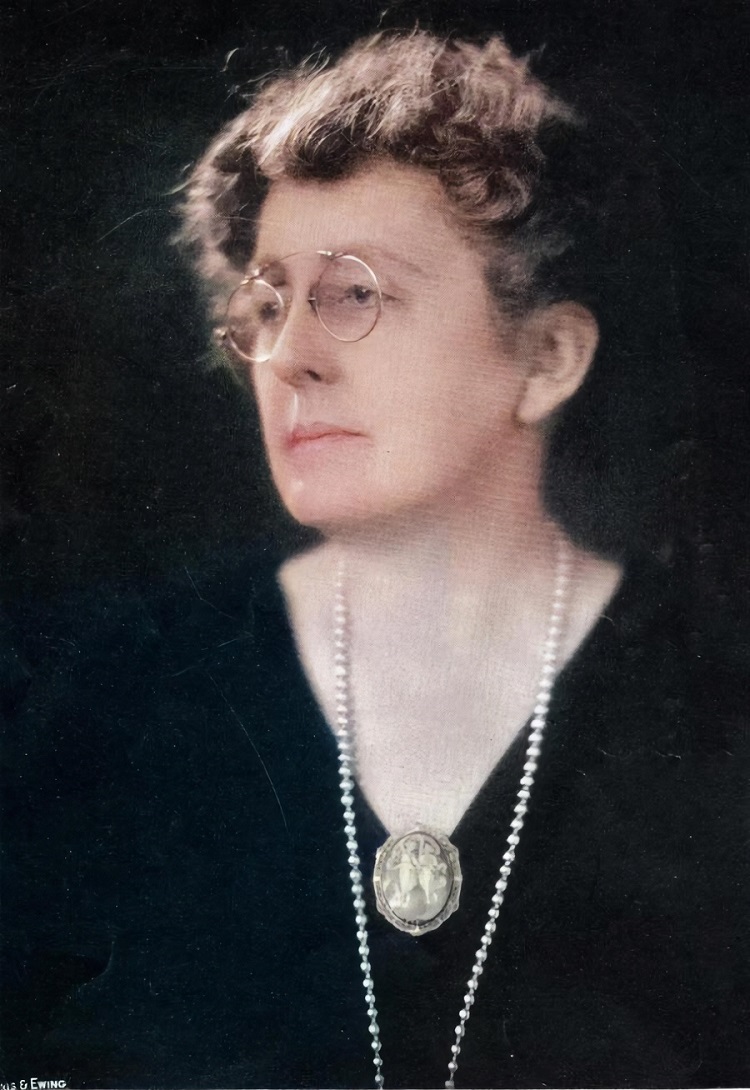
Augusta Dillman Thomas was born in Pottsville on Thanksgiving Day, November 28, 1872, less than three months after the death of her father attorney, Daniel D. Dillman. In early 1873, Augusta, with her mother and two small brothers, moved to Mahanoy City, the home of her grandfather, Peter Bowman who was a local coal mine operator.
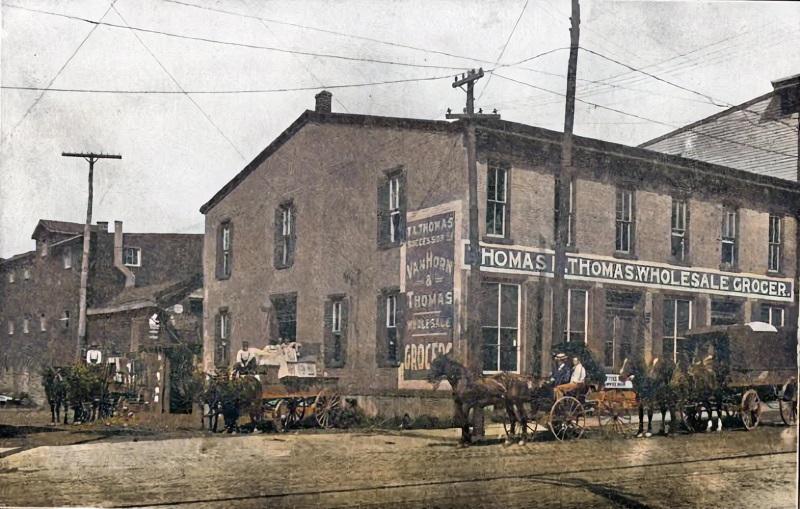
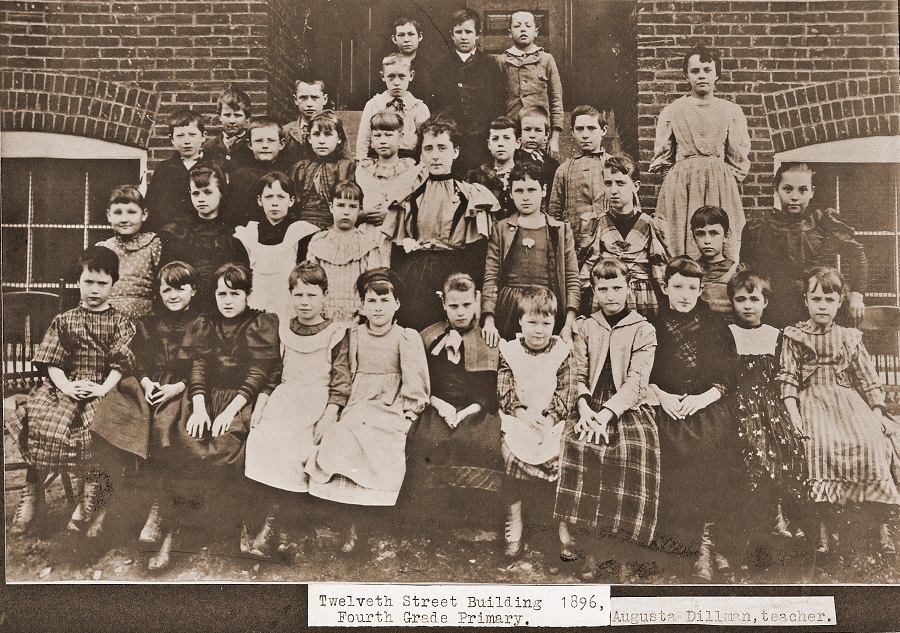
Augusta attended local schools and graduated from Mahanoy City High School in 1891. She entered West Chester State Teachers College and graduated in just one year with the class of 1893. She returned to Mahanoy City and took a position as a teacher at the 12th Street School. She taught in the local schools for eight- and one-half years until her marriage to local wholesale grocer Thomas L. Thomas on February 21, 1901.
According to the Record American, Augusta’s “life was a busy one. Widely traveled, she visited forty states, Puerto Rico, Canada, and in 1937, she made a trip around the world visiting nineteen countries in Europe and Asia. “
During World War I Augusta was the chairwoman of the Mahanoy City Chapter of the American Red Cross and wrote a history of the Chapter. Later she wrote A History of the Mahanoy City Public Schoolsa series of sixty-six articles which appeared in the Record American during the entire summer of 1925 from June 17 to September 2.
Augusta frequently wrote articles for the Schuylkill County Historical Society and published two books – History of the Bowman Family and a novel about her days as a student at West Chester State Teachers College entitled One Crowded Hour.
Augusta was a member of the Daughters of the American Revolution and numerous other patriotic organizations. She was a Fellow of the American Genealogy Society from which she received the Certificate of Merit.
Augusta Dillman Thomas died in Scranton on January 11, 1952, at the home of her daughter Muriel. She was survived by her other daughter Vivian.
Over the years the Mahanoy Area Historical Society has collected fragments of a history of Mahanoy City written by Augusta Dillman Thomas. These fragments, sometimes many pages, sometimes just a few came to us in a rather disorganized form. We have taken time to organize, edit and transcribe this book length work which we call Augusta Dillman Thomas’s History of Mahanoy City. Much credit goes to Barbara Ward for the numerous hours she spent transcribing Augusta’s history into a Word document. Barb is a 1984 graduate of Mahanoy Area High School and the daughter of Dorothy Ward and the late Thomas Ward Sr., a former president of the Mahanoy Area Historical Society.
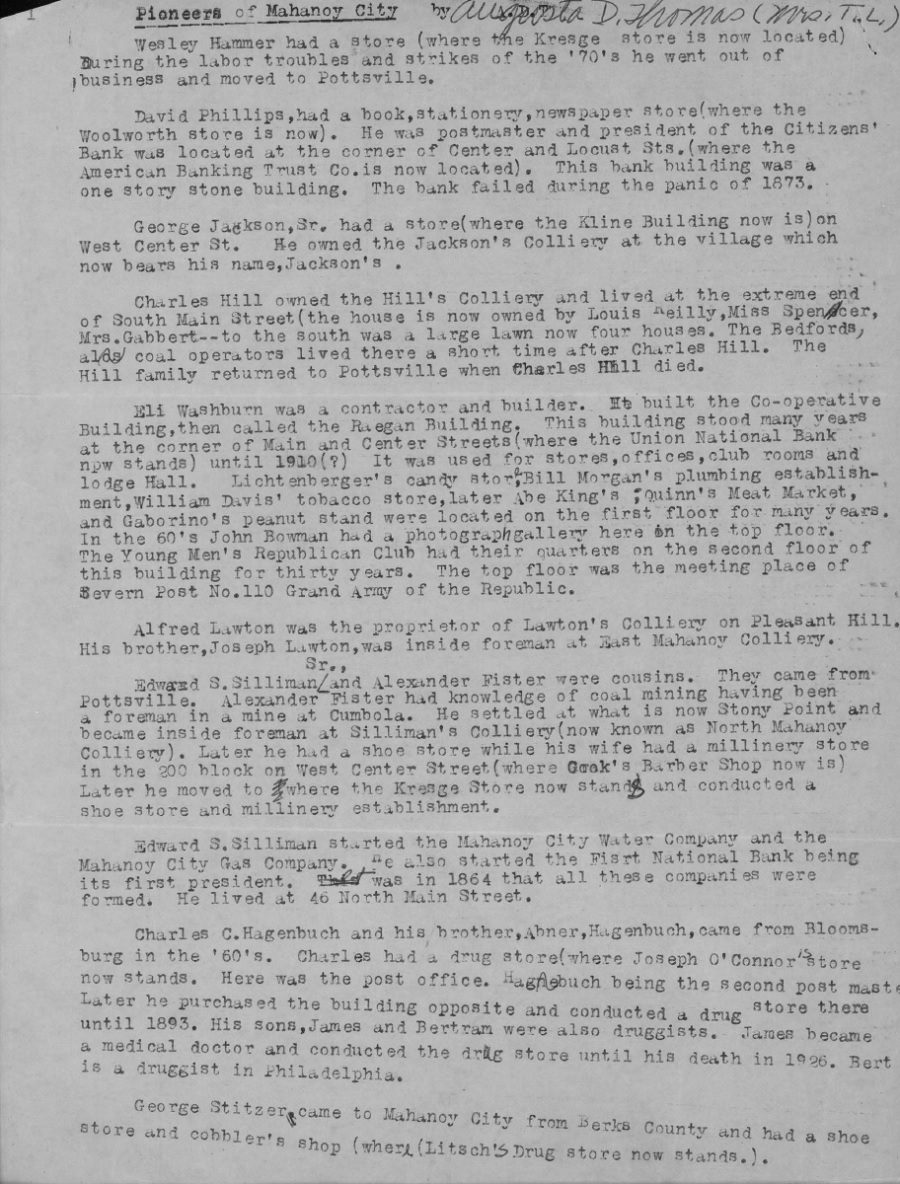
The page above is from a collection of papers obtained from the Mahanoy City Public Library by the historical society. It was these pages that Barbara Ward transcribed to a Word document
The first Chapter of Augusta’s History of Mahanoy City is entitled Reminiscences of Mahanoy City. This chapter appeared in the Record American in eleven installments in May, June and July of 1939 in a column entitled Of Books and Things by Joe Davies who was Augusta’s cousin. After Augusta moved from Mahanoy City to Scranton after the death of her husband, her cousin Joe Davies became the unofficial Mahanoy City historian assisted by Elwood M. Young and Charles Engle. These three compiled a book entitled Mahanoy City 1863-1963 – A Centennial History. Davies, Young and Engle had been working on a history of the borough for a number of years after there had been a previous attempt to compile a comprehensive history of Mahanoy City in preparation for the borough’s 75th anniversary in 1938. Augusta’s history is probably part of that work which had never been published beyond the Reminiscences which appeared in the Record American in 1939. Her other writing for this history, Chapters Two to Seven , were never published until now. The links for these chapters appear at the bottom of this page.
Davies, Young and Engle compiled over 900 pages of manuscript in preparation for publication of Mahanoy City 1863-1963 -A Centennial History. In its final form the book consisted of ninety-seven pages with seventy-five pictures, mostly from the collection of Elwood M. Young who had a wallpaper and stationary store next to the Teen Canteen. Augusta’s work is quoted often, in fact the chapter on first families of the borough comes entirely from Augusta’s writings.

Chapter 1 - Reminiscences of Mahanoy City by Augusta Dillman Thomas
At times, writings as well as conversations, drift backward "to the good old days" of romance, of freedom, of domestic tranquility. To many of us these days are but a fairy tale oft repeated by our parents when we ask for a bedtime story. Those, who then lived, worked, toiled, loved, grieved, are gone but their memories still remain with us. To many, those days of horses and wagons, candle dips and kerosene lamps, are endeared to memory. Yet they were days of hardships, but our parents and grandparents did not think so. The thoughts of youth are always happy ones. Perhaps, I may here and there touch a tender chord of yesterday.
From actual experience and observation, I know nothing about Mahanoy City in the '60's and very little in the '70's. I was a very little girl when I entered the first grade of the public schools in 1879.
Mahanoy City was founded about 1859 or 1860. It was incorporated as a borough in 1863. My maternal grandfather, Peter Bowman, arrived in this wilderness and swamp land in April, 1862, to operate the Bowman Colliery.
Coal was discovered here in 1861. New mines were opened and settlers from Berks, Lehigh, and Carbon Counties came pouring into the new settlement. They were chiefly merchants, carpenters, mechanics, professional men, and schoolteachers. Welshmen from Minersville, Pottsville, St. Clair, and other towns came in great numbers to operate the mines having had that occupation in Wales. Their arrivals were augmented by English miners from these sections of Schuylkill County also. Irish emigrants poured into the town in great numbers. The population rapidly increased. In 1870, possibly, Mahanoy City had seven thousand inhabitants. There were not very many German emigrants in comparison to the numbers of other nationalities. The Lithuanian, Pole, Slav, Greek and Italian did not come into our midst until a later decade.
Mahanoy City lying in the valley with high mountains on either side with the Mahanoy Creek nearly dividing it in two parts and flowing westward its entire length, had many possibilities for pioneering.
One of the early features of the town was a brewery on the hill at the southern end. This hill was known for fifty-eight years as Brewery Hill. During the World War the name was changed to Liberty Hill and one portion is known as Spruce Lane.
The Philadelphia and Reading Railroad Station was at the north of the creek opposite the 200 square of east Railroad Street. The first train came into the station (in) 1862. The Lehigh Valley Railroad was west of this station toward the north. The first Lehigh Valley train entered the town on November 3, 1863.
For many years before the town was founded, Main Street was a public highway leading from the Mountain House to Ringtown. Catawissa Street was a pike leading to the Catawissa Valley. Horse drawn carts and wagons were used. No pavements nor curbing was to be seen for many years. There was no drainage in the early days. Soil water was thrown into the back alley over the back fence. Pigs, goats, and cows roamed at will over the streets. The streets were not illuminated until the '70's. When one wished to go out of an evening the lantern was lighted and carried along so one could walk without stepping into a puddle of water or falling over a stump. Maybe the younger folks did not take a lantern because they did not wish to be burdened. Stumps of trees and swampy land made it dangerous to go out without a lantern.
The first houses were not noted much for architectural beauty. The homes of the coal operators were more substantial, but the working men's houses were largely a production of job carpenters, and a few God gifted plumbers completed the jobs. Wooden pavements and a very, very few brick pavements were placed at several houses. The majority of the houses were unpretentious being built of wood, in the manner of a box with square openings for doors and windows.
Lots were twenty-five feet by one hundred and twenty-five feet. Lawns were placed in front and rear of the house but as ground became scarcer and more valuable the houses were moved front to the street line and another house was built in the rear of the lot. Then the houses were made into double houses of twelve and a half feet. Thus, there were four houses on one lot of twenty-five feet frontage.
In the First Ward we often find six houses on one lot -- but of course this was not the case in the earlier days of the town. Several large homes were built by Col. Raegan at Main and Spruce Streets, by Col Porter on Main Street, by Charles Hill on Main above Spruce, Frank Carter on East Spruce Street, David Stewart build a house at the southwest corner of Main and South Streets, and also built the houses at 75 and 77 South Main Street and lived in one of them. Jonas and Peter Bowman built large homes at 126-128, 130-132 East Center Street, and David Bowman lived at the corner of Main and Mahanoy Streets. George Wiggan built a large mansion surrounded by beautiful trees at the southeast corner of Center and Linden Streets, Samuel Parmley had a home at the southeast corner of Catawissa and Center Streets. In the late '60's, Eli Washburn built the cottage row on West Mahanoy Street in the 200 square. Captain John F. Schoener came from Berks County early in the '70's. He was a carpenter and built many rows of houses. The houses numbered 94, 96, 98 on South Main Street were built by him. On East Mahanoy Street he built the houses numbered 17, 19, 21, 18, 20, 22 and 408 to 426 East Mahanoy Avenue. This last row of houses was known as Methodist row because it was in the same square as the Methodist Church and also because so many Methodist families resided in these homes.
Peter Otterbach built a large pretentious home in the 700 square on the north side of East Center in the '70's but before it was completed his young wife and son died. Their graves may be seen in the Protestant Cemetery on the hill. Many years this beautiful mansion was unoccupied for the young husband could not bear to live where he and his loved one had hoped to pass many happy years. For many years it was rumored this house was haunted and many a person trembled with fear when he passed that way at night. Finally, it was rented to several persons but in 1887 Charles D. Kaier purchased it and now it is the home of his daughter, Mrs. Lloyd Fahler.
Giant shade trees surrounded these homes until the later '80's when they were hewn down to show progress as beauty was not considered an asset. Awnings constructed of wood were in front of the stores extending in an unbroken line on Center Street and there were also several on Mahanoy Street. This of course was a great protection to shoppers when it rained or for loafers, who might be caught in the rain while out of an evening conversing about the topics of the day and settling the momentous questions of the country instead of being at home assisting their wives by carrying coal, ashes, or helping to attend to the numerous children in their homes.
Outside of several stores were carriage blocks for the persons to step upon when alighting from the carriage. There were also hitching posts for tying horses. I remember two such posts, each in the shape of an iron Negro boy. These stood in front of George Wren's residence and Kaier's liquor store. As a child I thought these were the most wonderful pieces of sculpture I had ever beheld. A watering trough for horses stood in front of a tavern at 22 East Center Street. Wooden Indians stood on the pavement in front of Grim's Tobacco Store and in front of Davis's Store on Main Street. Oil lamps placed at the top of seven foot iron lamp posts gave illumination in the latter '60's and early '70's. This was superseded about 1875 by gas lamps. These posts were at every second corner on the main thoroughfares.
Every evening at dusk the policeman, Jacob Rudl, would light these lamps. On January 16, 1888 the electric arc lights at the center of the intersection of principal streets took the place of gas. The carbons in these lights were renewed every morning. Stores were lighted by kerosene in the '60's and, gradually, in the '70's gas was used in the place of oil. About 1886 the arc lights were placed in stores. D.J. Cleary's store was the first to use electricity.
The first telephones came into the town in 1882. David E. Focht, E.P. Lear, Simon Trier, Jacob Mayer, C.D. Kaier, Dr. Phaon Hermany, Mansion House and Derrick House had phones installed. These first phones hung on the wall; each had a bell at its side. This bell had to be rung before anyone could talk on the phone.
Travel was by wagon; ox team and horse and mules being used. Many sports of the town owned beautiful horses and the livery stables owned by Charles W. and Charles O. Smith, and Adam Brown did a very lucrative business. During heavy snowstorms when the snow had accumulated, as it seemed to do in those early years, sleighs were used exclusively. The country hotels were well patronized by sleighing parties for miles around. Barnesville, Brandonville, Ringtown and Schuylkill Haven were popular places for these sleighing parties. These sleighs held some twenty-four persons -- the seats being on the sides facing each other. Charlie Smith's "Mountaineer", as the large sleigh was named, was very popular. Livery stables did a thriving business at this time. What could be nicer than a "cutter" (this was a single sleigh accommodating two persons) and a horse to take your sweetheart for a long ride on a moonlight evening! Ice skating at the small pond near the Foundry on West Center Street, at Primrose Dam, East Mahanoy Junction, and numerous other ponds was very alluring to the young ladies and gentlemen. A chicken and waffle supper after the skating or at the end of the sleighride was something to be anticipated. Today, the young folks go to the country clubs by motor and dance to jazz music. Which would you prefer?
Let us return to the pastimes, social activities, and household employments of the early and later days of Mahanoy City. Old fashioned housekeeping was aided by Bridget , Lena, Molly or Barbara. These assistants received 50 cents, 75 cents, or $1.00 a week on the '60's. In the '70's wages for household assistance were practically the same. In the '80's excellent servant girls received $1.50. In the '90's able servant girls received $1.75 to $2.00 a week but no more. They did general housework. During the post-war period of 1920 from $5.00 to $10.00 a week wages were paid. Sometimes the work was not satisfactory, but the factories and stores had taken the majority of expert workers. In the early days the housework in private dwellings meant stoking several stoves all winter, baking, washing, ironing, cooking, running up and down stairs to answer doorbells, pumping water from outside hydrants for laundry or bathing purposes.
Water was not placed in houses until the '70's. Hot water was not known to come from spigots until well on in the '90's. Of course, there were about twenty homes which had both hot and cold water with possibly ten families who had bathtubs, in the town prior to the '80's. The old wooden tub was in constant use on Saturdays. A bath was taken only once a week. The miners were the exception for they had a bath every afternoon in the old wooden tub after the day's work was over. Imagine the miner's mother or wife heating all that water by means of kettle and boiler for her many male members of the family who worked at the mines or colliery.
Bread was baked by the housewife. A few persons made yeast selling it for a cent a cupful. The children of the household would go for the yeast in the evening. The bread was set to rise at night and baked the following day. Now, to make bread, a "starter" or compressed yeast is used. Most people buy their bread since the World War. The large brick bake-ovens in the back yard were used at first until cooking stoves became more generally (available).
The children all knew where the lime kiln was located. This was on Eighth Street, across the Philadelphia & Reading railroad tracks. The children were sent every spring to buy a peck or a bushel of lime to whitewash the cellar, fence, or chicken-pen. Now, since people whitewash the cellar, only, lime is bought at the lumber yard or the hardware stores, and the lime kiln is only a memory. The kiln was owned by John Myers.
During the earlier and middle period of the town's history, from the '60's to the '90's, the decorations in the homes were bizarre. Pictures were edged with pink ribbon bows at the upper corners. Wax flowers were donated to funerals and kept in glass cases for many years as ornaments in the parlor. There were also flowers made from the hair of beloved and departed members of the family. These were framed and adorned the walls of the parlor, or as we call it now, the living room. Lovers exchanged locks of hair and had them placed in rings or bracelets for their beloved.
On the corners of small tables scarfs were draped in the middle and held in place by the family Bible. The said Bible weighed about twenty pounds. Mantels were also draped with a scarf in the same manner. Crayon portraits became the fashion in the latter '80's. In the early '90's pastel portraits were the vogue, and every parlor wall was adorned with the likeness of father and mother. Horsehair parlor suites were the rage in the '80's. Horrid things! You never knew when you would slide from them. The children seemed to enjoy this, however. One corner of the parlor was outfitted with some sort of a contraption having a canopy effect, supposed to be Turkish or Moorish or spookish. This was known as a cozy corner. Here the young lady of the house would sit playing the guitar or mandolin when the young gentlemen called. There seemed to be a hectic idea to drape and to have heavy hangings in every available space.
The homes were lighted with gas if the owners were able to afford it. If not, coal oil was burned. Many pretty lamps on onyx tables and floor lamps with kerosene were used. These gave way to the incandescent lights in the 1900's. How one ever sewed or read with the light of these kerosene lamps upon the printed page is more than one can conceive now! Tallow candles were used by many who were too poor to afford kerosene lamps. These lamps were cleaned, filled with oil, and trimmed every morning to be ready for the dark nights spent indoors.
Fancy work for the ladies has varied from the days of the '60's to the present time. In those early days, patching quilts and sewing carpet rags for carpet was their favorite indoor sport. Knitting socks, gloves and sewing undergarments as well as outer clothing was also of much importance because factory made dresses were not yet known. Dressmakers and tailors made the outer clothing if the housewives were not adept at that trade. In the '70's came the frenzy for crazy patchwork quilts made from silk and velvet. In the '80's the tidy or antimacassar craze came. These little ornaments were made of macrame cord and when completed were placed at the back of the upholstered chair.
After this came the painting craze. This struck the town about 1882. Photographs were mounted on glass and then painted. These were called ivory types. Next came the oil painting mania. Miss Minnie Whitney came from Pottsville once a week to teach a class of thirty would-be artists. This lasted about two years and many ladies and gentlemen became quite proficient in that work.
The decalcomania and paper flower craze followed but this was only used for a short time on banners and novelties. About 1885 Kensington painting arrived. This was accomplished by the use of a pen and oil paints on plush and velvet. Arazene work and embroidery followed. The advent of drawn work and colored silk embroideries marked the '90's. This continued until the 1900's when mercerized cotton was used in the place of silk to embroider and during the War knitting became popular. Mahanoy City alone contributed to the Red Cross 2081 sweaters, 839 pairs wristlets, 456 mufflers, 131 helmets, 60 Afghans, and 1199 pairs of socks. The oldest knitter was Mrs. Bartolet, aged eighty-four years and the youngest knitter was Mary Lewis, aged four years. There was also a revival of patchwork, applique, and crocheting during the pre-war and post-war period.
The '80's and '90's seemed to be the golden age of plush. The ladies had plush coats and the boys plush hats. Parlor furniture was upholstered in plush. Picture frames were covered with plush. Dolmans and sacques were made of plush. Dresses were trimmed with it. During the painting craze the young ladies painted brick-a-brack. Jugs were painted and so were coal buckets and fire shovels. These were placed in the parlor alongside painted three-legged stools and tied with bright colored ribbons. Plaques made of plaster of Paris with Gibson girl heads pasted upon them were supposed to be very artistic in 1915.
The photograph album was also in evidence from 1870 to 1900. Every family of any pretentions owned one. When visitors came the album was brought out to be looked at and enjoyed by all. The stereopticon with its variously colored pictures served to pass many an evening and helped along conversation. The autograph album was also a constant source of amusement and pleasure. Several years ago, an attempt was made to revive the autograph album but to no avail in this dizzy jazz age. Many years ago, every young lady owned an autograph album. These were usually bound in plush of various bright colors with gilt edges and the loveliest robin egg blue paper interspersed with salmon, gray, pink and buff paper. It was customary to have one's friends and acquaintances indite (compose) a verse, tender, facetious or admonitory, such as, "Be good, sweet maid, and let who will be clever, etc." This was a favorite selection of a reprobate old uncle or cousin. Another might run thus:
"In the journey of life when you need an umbrella
May it always be held by a handsome young fellow."
That was supposed to be the last word in humor. Yet the autograph album is a tender memory anyway.
Elocution played a large part in the life of Mahanoy City. Those who were fond of poetry and could memorize readily were always in demand for recitations at the various church literary societies of the town. Among the Welsh people, elocution reached its highest development at the Eisteddfods. William Reynolds, a Welshman, was quite noted for several recitations mainly, "Coney Island down der Bay", "Shamus O'Brien", and "Jimmie the Whaler".
Music was always much appreciated in our town. The various church choirs were led by excellent musicians. There were many choral societies but the one that stood out most prominently in the '70's was the Orpheus Club, the pianist being Mrs. Emily Ritter. The Welsh population held many eisteddfods, but the outstanding musical feat was the presentation in 1896 of "Belshazzar" with Prof. Reese Rosser, Sr. as leader.
The Methodist Episcopal Church presented Queen Esther in 1892. Of later years eisteddfods have been many and have also been very successful. Different members of all church choirs competed in these concerts. On April 19, 1888, an operetta entitled "Laila" was produced by local talent in Kaier's Opera House. Misses Emily Leitenberger and Hattie Porter were the soloists, while Miss Dettie Skeath was pianist. Charles W. Walbride played the violin and Howard Bensinger the cornet.
The choir of the early Mahanoy City High School Alumni Association had many excellent voices. The orchestra of this organization was also in great demand from 1879 to 1900. During the last six years, the Orpheus Choir under the leadership of David B. Davies is an active organization. Among the many singers of which Mahanoy City boasts are the following: K. Maude Smith, Emily Leitenberger, Freda Schatzlein, Estella Barnhart, Annie Wynn, Sallie Wynn, Emily Tregellas, Emilie Yoder, Elsie Reid, Elizabeth Mates, Helen Jenkins, Sarah Jenkins, Julia Gorman, Katherine Moore, Hattie Wagner, Melara Mengle, Carrie Snyder, Josephine Petrasavicz, Sue Hermany, Marian Heiser, Mae and Helen Rajkowski, May Harlor, Melinda Wagner, Ethel Harlor, Helen Kubert, Helen Hinch, Mrs. Rose L. Whittaker, Mrs. Bertha Maese, Mrs. Myrtle Wagner, Mrs. Alzina L. Heiser, Mrs. Catherine Rosser, Harriet Reyn, Gwennie Williams, Mrs. Maude Wren, Mrs. Minnie Giffin, Mrs. Joseph Hughes, Marie Cronin, Charles Snyder, William Edmunds, Nicholas Thomas, Joseph Davies, David B. Davies, John F. Davies, William H. Snyder, John W. Davies, Edward F. Snyder, Robert C. Smith, John Lewis, Sr., John Lewis, Jr., Reese Rosser, Sr., Reese Rosser, Jr., Edward Rosser, Thomas Rosser, Thomas Price, William Price, Joseph Lewis, William Henninger, Edward Scheirer, Albert Scheirer, E.P. Lear, Carl Zellers, J. Arthur Jones, Thomas Tregellas, Joshua Jones, James Haughney, James McInerney, Rees T. Reese, Daniel B. Davies, John B. Davies, Alfred B. Wagner, Homer Bagenstose, Adam Wingert.
The following persons were music teachers in Mahanoy City: Joseph Swain, Alfred Cook, Charles Walbridge, John Schmidtman, Alfred Wagner, John J. Jones, Hattie Harper, Millie Harker, Tillie Severn, Mrs. Wm. E. Ehrhardt, Mrs. Jennie Snyder, Clara Yoder, Pauline Weber, Dettie Skeath, Ida Barlow, Mrs. Abi Marsteller, Mrs. A. Masur, Guy Dower, Harry Katee, Albert Becker, Charles Domson, Mary Collins, Mary Quinn, Bertha Lefkowith, Kathryn Gabbert, Mary Davidson, Violet Moikitis, Julia Gorman, Harry Harris.
The Citizens' Cornet Band was organized in April 1868. Its first leader was Jacob Britz. The other leaders were William Smith, Henry Ferg, Stephen Gorman, Philip Francis, John Harlen, Newton E. Reed, and Harry Harris. The Lithuanian Band was directed by Charles Unsinn who also conducted the Germania Band. John Johns was leader of The Liberty Band for several years.
In the early days of Mahanoy City the people were much interested in drama and theatricals. A town hall was built very early in the history of the town. At the corner of Market and Main Streets (where the Victoria Theatre now stands stood the town hall). Constantine Metz was the proprietor in the latter '70's and early '80's. Private theatricals were given as a means for raising money for the Grand Army. Many of our older men can remember the following plays given by local talent: "The German Volunteer" and "Libby Prison".
In 1889 the Presbyterian Church sponsored a pageant which was entitled "The Business Men's Carnival". All the businessmen in the town contributed a certain amount of money to the project. Two evenings it was held in "old" Kaier Opera House. Four hundred children took part, each one representing a business place in the town. Four acts told the story of Mahanoy City's enterprises. Many and varied were the costumes and each child or group of children recited a verse about the business place he or she represented.
The amateur production of "Ben Hur" in 1900 was a very beautiful rendition of that wonderful play taken from General Lew Wallace's book of that name. Jesse Webb as "Messala", David L. Thomas as "Ben Hur", Melara Mengle as "Iris", and Katherine Wagner as "Esther" were well cast for these parts. William Shaffer and Richard Phillips took the parts of "Messala" and "Ben Hur" as boys.
But the real theatrical performances were many and varied. Such noted persons as Modjeska, Mantell, Young, Lotta, MacLean and Thompson came to Kaier's Opera House. On June 27, 1889 Ada Gray appeared in "East Lynne"; Katherine Pearson in "She" on April 2, 1890; in 1891 Lotta came in "Musette"; R.D. MacLean and Marie Prescott in "Cleopatra"; and Lewis Morrison in "Faust" the next year. These plays were all held in the old Kaier Opera House on the second floor with the entrance on Market Street (the original town hall).
Early in the '90's Charles D. Kaier built the beautiful Kaier Opera House. In this Opera House were played the following: "Bachelor's Honeymoon", "Love and War", "Uncle Rob", "Leah, the Forsaken", "Princess Bonnie", "Hogan's Alley", "A Member of Congress", "The Prisoner of Zenda", the opera "Wang", "The Merry Widow", "Other Peoples' Money", "Isle of Champagne", "Bleak House", "Lights of London", "The Waife of New York", "The Two Orphans", "Count of Monte Cristo", "The White Squadron", and "Shannon of the Sixth". Among the noted actors and actresses were: Robert Mantell and Minnie Monk, in "A Gentleman from Gascony" and "Secret Warrent", also in "Richelieu"; Denman Thompson in "The Old Homestead", James Young in "Richard III"; Lewis Morrison in "Frederick the Great" and "Faust". Creston Clarke in "The Last of his Race", James O'Neil in "The Count of Monte Cristo"; Rhea in "The Empress of France", and Walter Wilson in "Darkest Russia".
In November 1896 John Philip Sousa gave a concert in Kaier's Grand Opera House. The inimitable "March" King was long remembered for the manner in which he conducted and lead on that memorable occasion.
The Ladies Symphony Orchestra played in Kaier's Opera House November 3, 1897 and Victor Schertzinger, Mahanoy City's child violinist aged seven years had a concert here on April 27, 1897. The Welsh Prize Singers came from North Wales and gave a concert here in 1902.
During the '90's, Mahanoy City was much interested in hypnotism. Many professional hypnotists came to town to demonstrate their ability. These demonstrations were held in the Hersker and Kaier Opera Houses. The Hersker Opera House is now the Family Theatre. One of their stunts was to hypnotize a man for a period of thirty-six hours. He was then removed from the opera house to a large store window where passersby could view him for that period of time. Here he would lie in that hypnotic state while the morbid crowd would gaze in wonder, awe, or derision as they felt inclined. When the time had expired the hypnotic "professor" would clap his hands and say "Arise". The victim then arose none the worse, apparently, for the experience. Another form of entertainment of this period at the opera houses were magicians. Kellar, the great magician, came very frequently to Kaier's Grand Opera House, which was filled with the curious people to see what Kellar would do this time. This magician was very proficient in bringing rabbits, dogs, etc. from hats and billiard balls from young men's pockets. (Billiards in those days was not considered the right game to play. Consequently, the young men would be very much chagrined.) At one time he took a rag doll from his high silk hat. The doll kept crying, "Papa! Papa!" Kellar asked, "Is there any person in the audience who owns this doll?" Receiving no response he left the stage and wandered into the audience, (and) finally amidst great laughter placed the doll in the arms of a young man who was standing in the rear. Kellar had a cabinet on the stage. He opened it showing that the inside was empty. He ran his sword through it many times in all directions to show the cabinet was empty. "Now is there anyone in the audience who is not afraid to enter this cabinet" he asked. One brave man, Thomas Joyce who feared nothing, volunteered to enter. Jauntily, he walked upon the stage and entered the cabinet. He was only in it thirty seconds. When he came out of the cabinet his clothes were wrong side out. He was very much scared saying, "there were a thousand devils tearing at my garments."
The minstrel shows put on by the Young Men's Republican Club were a yearly feature of the '90's. The following young Republicans were famous in these shows of their club: James H. Kirschner, Charles Hendricks, Edward F. Snyder, Robert Heiser, Frank Snyder, Luke Daley, William Price, Bert Koenig, William Patterson, Howard Burchill, Will Richards, John Lewis, William Kirschner, David B. Davies, Robert C. Smith, Peter Dennis, William Grainger, John Jones, James Comerford, Daniel O'Neil, with Thomas L. Thomas as interlocutor, gave much enjoyment to the theatre going people of that period.
The first moving pictures were displayed in Hersker's Opera House and were also shortly afterwards in Kaier's Opera House, probably about 1900. Later, the Ekls Theatre was opened when that building was erected and moving pictures were shown here. At the corner of Center and Third Street was a Nickelodion where moving pictures were shown. The "Palace Theatre" was at the northwest corner of Main and Pine Streets where many beautiful silent pictures were shown, among them being "Queen Elizabeth".
The first phonograph in Mahanoy City was heard in Kaier's Opera House about 1895. Dr. Louis Weber brought it from his home. It was a box about three feet long and a foot and a half wide. Cylinders were used instead of disks. An immense horn conveyed the sound from the stage to the listeners ears. Dr. Weber continually remonstrated with the audience not to laugh, as much of the record would not be heard if there was not complete silence. The imperfect tones coming through the horn caused much laughter on the part of the audience.
The Armory Hall on East Pine Street (121 to 131) was also used for home talent plays, lectures, club meetings, fairs, suppers, bazaars, and dances. The Silliman Guards met here and drilled. When this company became Company E of the National Guard of Pennsylvania, their equipment was stored here. This company used these rooms until they were mustered into the United States service during the World War. This hall was burned in 1922 and since then eight houses have been built upon its site. The Armory Hall was the English Baptist Church in the '60's and early '70's but when the congregation became too small to continue, the building was sold and used later as a public hall.
Literary Societies in the different churches, such as St. John's Lutheran, Presbyterian, Episcopal, and Methodist were a source of much pleasure from the '70's to 1900. A Shakespeare Club was formed in the '80's and again revived in the '90's. A Dickens Club was also formed in that decade which later became the "Reading Circle". A Chautauqua Circle was formed in 1878 and another one in 1893. The first was sponsored by Eli S. Reinhold and the later one by Mrs. Jane M. Lyon.
From the '60's to the 1900's, surprise parties were much in favor. These parties may seem simple to the present generation, but they were none the less enjoyable. A few days before the party a note would be received requesting you to meet at a friend's house. The note read thus:
Dear John: You are respectfully invited to attend a "surprise" party for Sally Thomas. Meet at Mary Smith's house at 7 P.M. on Tuesday Evening Sept. 16th. Bring lemons for lemonade.
The last line was changed in each invitation so a variety of eatables would be contributed. Armed with the offering suggested in the last line, you sallied forth to the meeting place. When all had assembled at that place then all went in a body to the home of the young lady who was to be surprised. Occasionally, the young lady would really be surprised in the delightful but unromantic occupation of helping mother wash the dishes. At other times she would be all dressed ready to go out when the crowd of friends arrived. Upon hearing the shouts of "Surprise! Surprise!" she would be very much overwhelmed. This little bit of harmless fiction in no wise detracted from the pleasure of the evening. Games were enjoyed until nine o'clock when refreshments were served, and all departed for home at ten. If you did not arrive home in ten or fifteen minutes you would see your father or mother coming down the street to know the cause of delay. Those days are gone forever, for now the young folks stay out until three o'clock or later in the morning.
Card playing was not indulged in to any extent until the '90's. The churches did not approve of cards. Some persons did play, but they were the exception. Cards were only used as means of gambling in the early days. In the 90's cards became more popular and the one game enjoyed was Duplicate Whist. Euchre, and Casino were also played. In the 1900's cards were more in evidence with Five Hundred as the popular game. Later in the pre-war and post-war periods auction bridge and contract bridge became the card games of the social set. Women played morning, afternoon, and evening. Prizes were given and later small sums of money were used. Pinochle is the game most enjoyed by the men. The other games of the olden days are still used by many, such as: parchesi, halma, checkers, dominoes, and chess.
Dances or "Hops" in the early days were indulged in by the young men and women past the "teen" age and the young married couples. Dancing was not sanctioned by all the churches as it is now, with a few exceptions. The dance began at eight P.M. The closing dance was 12 P.M. This was in the '60's, '70's and '80's. In the '90's dances began and closed an hour later. I do not know the exact time they close now. The first real ball for the people of Mahanoy City was held in the Mansion House November 3, 1863. The belles in crinoline and beaus with whiskers adorning the side of their faces, danced until midnight and many "a heart beat happily" and "eyes looked love to eyes that spake again".
The firemen held balls at certain intervals charging twenty-five cents a ticket, with dancing until 12 P.M. The proceeds were used for the fire house or apparatus. Square dances were the most popular in the '60's, '70's and '80's although Strauss' waltzes were very alluring. The square dances such as the Cledonian, Lancers, and Quadrille were most in vogue. Their popularity waned in the '90's when the waltz and two-step became the fashionable dances. The older folks continued to like the square dance with its different figures called out by the orchestra leader. The effect was most pleasing to the onlooker and participant as he called "swing partners", "ladies chain", "gentlemen to the center", "ladies to the center" and the grand finale "all hands around". Much merry-making ensued. In the '80's came Varsovianna, Mazurka, Schottishe, Polka, with the ever-popular waltz and two-step. The latter was considered very hoydenish. Shades of our grandmothers!' What would they have said if they had seen the "Bunny Hug", "Tango", "Fox Trot", "Blackbottom", "Rumba", "Continental", and "Charleston" of the pre-war and post-war period? The dances of the present decade have become more sedate.
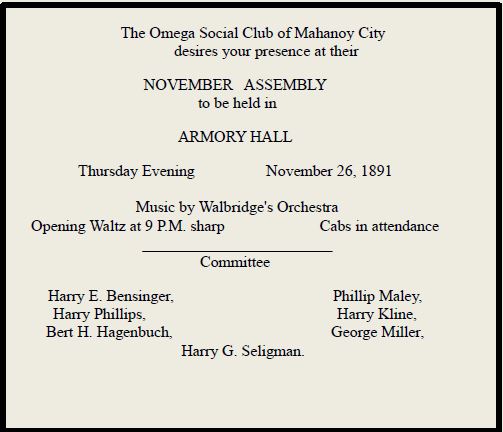
The following invitation is one of the many sent out by the Omega Social Club of Mahanoy City. As one of our clergy said one Sunday morning, "Do you fellows who are sponsoring this dance know what "Omega" means?" I cannot say if this was really the last one to be held after this cryptic remark or not.
Picnics were a great source of amusement during the summer.
The picnics of the earlier days were very different from what they are at present. The first picnic ground of which there is any knowledge was back of where the First National bank is now located. Young ladies took baskets of lunch, and the invited guests were the young gentlemen of the town. The tablecloth was spread on the grass and the lunch much enjoyed. This was in 1868. In the '70's a picnic grove at the east end of town in the 700 square provided joys for the many Sunday Schools.
The fire companies had picnics and dances at Pleasant Hill. At these gatherings ice-cream, soft drinks, and, I regret to say, hard drinks were sold. By imbibing too much of the latter many quarrels arose, and fighting was a frequent occurrence. The Sunday School picnics were held in the '70's at Smith's Farm (which is now back of Hill's village). In the '80's the Lehigh Valley Railroad opened a grove between Trenton and Delano. The Sunday Schools picnicked here for many years, but the ground was very swampy and East Mahanoy Junction became more popular because of the Lake and the higher ground where the grove was situated above the railroad tracks. This was a delightful place overlooking the beautiful farming country. The clergy objected to the lake because of the many drownings and near-drownings which occurred there. They also objected to the hotel where drink was sold. The parents feared the children would be killed crossing the railroad track.
One picnic was held at Heidenreich's Grove at the East End of the (Mahanoy) Tunnel. It was a beautiful summer day, but a thunderstorm arose. There was no pavilion for shelter, so all the picnickers went into the train of cars standing on the siding. After waiting an hour for the storm to abate, the train gradually pulled for Mahanoy City. One young man was so angry he swore at his pastor. The young man was font of "the cup that both cheers and inebriates" and that was the reason his pastor did not go to the Junction. Both these men are now dead. The young man died from the effects of the poison his pastor was so anxious for him to avoid.
At these picnics games were played with the children. The adults had baseball contests and quoits. Lemonade was made in a new clean tub and the picnickers could have all they wished to drink, free. Small cantaloupes were also given free to the members. These articles had been donated by some philanthropic member of the church. The picnic day began when the train left Mahanoy City at 9 A.M. and ended at 7 P.M. Of course, some of the young people stayed until the late train at 9.30 for moonlight boating on the lake. During the day Reisig ran a "tallyho" from the picnic grounds to his hotel and back. These five seated narrow conveyances was drawn by four horses or mules.
East Mahanoy Junction later became known as Lakeside. The old picnic grove above the railroad tracks was abandoned and the picnic tables are now by the lake. Lakewood, to the north, is a comparatively new picnic grove. It was opened about 1914. An artificial lake was built where swimming and bathing are enjoyed. A dance pavilion and scenic railway are also much enjoyed here.
Two other picnic groves were very popular in the '90's. High Point Park and Humane Grove. High Point Park was located near Barry's Junction on the road to Jackson's via the Lakeside Railway. This was laid out by the Washington Hook and Ladder Company of our borough about 1895. Dances were held here and occasionally the Grand Army had campfires at this resort. The trolly road ran within a few yards of the grounds. The place was finally abandoned because it was undermined.
Humane Grove was on the mountain at the south of town on the road to New Boston. This grove was sponsored by the Humane Fire Company in 1892. It continued to be a favorite resort for several years but again the place was condemned for it was undermined. All traces of these former beauty spots have disappeared and the mine cave ins have spoiled the beautiful laurel and rhododendron bushes.
In 1883 the craze for tin-type photographs became very popular. These tintypes were an inch square and were called "Gems". Almost every person had a dozen photographs taken for twenty-five cents. One of the studios was located at the corner of Locust and Market Streets and another was at the corner of Center and Third Streets. For a year these photographers did a thriving business.
The first canned goods sold in grocery stores came into vogue in the '80's. Corn and tomatoes were the first of these canned commodities. The cans were about the same size as cans used today. The method of opening these cans was by the means of placing hot coals from the kitchen range upon the small, soldered center at the top of the can. Chocolate as a beverage came to town in the '80's as did also the luxury of bananas and oranges. Prior to this time these fruits were seen only at Christmastime.
Customs in dress of those early days of the '60's are many and varied. The men had beards and an enormous mop of hair plastered tightly over the left eye in a compelling curve. This gave him an austere look. The hair was literally soaked in grease. Special antimacassars or tidies were placed on chairs where the head rested so that the upholstery should not be soiled from the grease on the head. Paper collars were worn and then burned when their usefulness was over. At twenty, young men looked like old men because they wore beards which had been the style during the War of the Rebellion
(Civil War) only a short time before. Their clothing was like that which their fathers and grandfathers wore but I suspect their hearts were just as young as those of our sheiks of today, and probably they were just as foolish.
In the '70's and early '80's sideburns adorned the visage of the male and also chin whiskers came into vogue. Then came in all its glory, the moustache which lasted fifteen years. Many and varied was this adornment. Some moustaches were long and curled fantastically, which made them look like handlebars for a bicycle. Some were curled into tight curls at the end. Some were waxed standing out like vicious needles. The conservative man's hair was parted on the left side. Parted in the middle was the extreme style. Pompadour style came in with the '90's.
From 1860 to 1875 men wore the high silk hat known as the stove pipe hat. Stiff derby hats with a very low crown came into vogue in the early '80's and held sway for many years with the crown advancing in height as the years advanced. In the summer, straw hats were used and in the '90's a black guard or string was attached to the hat and the other end of the guard to the coat lapel. This was to keep the hat from blowing away from the owner. A gold watch chain with a charm attached covered the front of the vest. A man who wished to be ultra-fashionable had a silver or gold toothpick as a charm on his watch chain. Celluloid collars and cuffs were quite elegant in the '80's and early '90's. Trousers in the '70's were skintight; shoes were the "Congress" elastic gaiter. Flat pancake derbies were used in the latter '70's. In the '80's trousers became very wide just as we saw them a few years ago. Many men wore shawls and capes instead of overcoats in the '70's. About 1887 appeared the blazer style of summer outfit. These were worn by the young men. A many-colored striped coat with a sash around the top of the trousers at the waist and tied at the side was considered the last word in style. Children wore about the same clothes as their elders. The Fauntleroy styles for little boys came to Mahanoy City in the '90's. Boys wore dresses until they were six years of age and had long curls. When the Fauntleroy style came into vogue, little boys wore trousers at the age of four years. They still wore long curls and had waists with extremely large collars and cuffs. Of course, there were some boys who wore the ordinary short trousers until they were twelve years old and were immediately put into long trousers as soon as they went to work in the breaker.
In the '60's little girls had their ears pierced so they would be able to wear earrings when they were young women. In the latter '80's earrings went out of fashion and were not used again until 1925. Now the earring is clasped on the ear by invisible means, thus eliminating the ear-piercing torture.
The ladies in the '60's wore the crinoline or hoop skirt which was superseded by the long bustle of the '70's and the short bustle of the '80's. In the '90's the balloon sleeve came into style. Bosom pads of wire or horsehair and corsets of unyielding properties like ancient instruments of torture were endured for fashion's sake. High necked dresses with long sleeves and tight fitting basques with linen collars and cuffs peeping over the edge of the dress were the vogue in the latter '80's.
The Jersey was a great success in the '80's. This was a close tight-fitting garment much like the ladies' sweater of today but it fitted snugly about the person who wore it. The Jersey was named for Lily Langtry, a native of the island of Jersey, who was proclaimed the most beautiful woman in England by Edward, Prince of Wales, afterwards Edward VII. Every person wore a jersey and a cap to match set jauntily on the back of the head. The balloon sleeve of the '90's was superseded by the bishop and elbow sleeve of the 1900's.
The sleeveless dress came in after the World War. The hobble skirt held sway for some years before the World War and was replaced by the short skirt. This was a gradual evolution from ankle length to six, seven, ten, twelve, thirteen inches from the floor. Skirts have again become long and then a little shorter. The exit of the corset and long skirt have not given the women the freedom they desired.
In the '70's a glimpse of a lady's ankle was the limit of public indulgence. Cotton stockings, usually black in color, were worn then. The price varying from ten cents to fifty cents a pair. When the lower limbs became more obvious the price of stockings became $2.00 to $3.00 a pair which now fortunately has dropped to $1.00 or less. In the early days of our borough, heels of shoes were either high or low, but nothing as high as worn today. The color of the shoes was black. In the '90's tan shoes were worn but babies had shoes of many colors. Girls wore the spring heel shoe which consisted of but one layer of leather at the heel. All shoes were high - the leather extending from eight to ten inches from the heel. Low shoes were worn in summer in the '90's but never in winter. Men did not wear low shoes until the summer of the '90's. The low shoe did not come into permanent fashion until the World War with the advent of silk stockings and silk underwear.
In that period houses and public places were more generally heated by radiation and these light clothes could be worn with more comfort. The imports of hides from Russia had ceased and all available leather had to be used for the army. Also, the importation of silk from France caused the manufacture of silken garments to be more extensive. The heels of the shoes became higher and the women of Mahanoy City, generally, were walking on their toes. In the early days, women (and men also but not so generally) squeezed their feet into shoes a size too small. "It was so genteel to have small feet". Today women get the correct size and do not suffer from that discomfort.
The young ladies of the '60's wore their hair very high. This was known as the "high chignon". After this style had run its course the montague or "spit" curls came into evidence. This was a flat curl around the forehead. The bang next arrived. Lily Langtry, the famous beauty, sponsored the bang, which held away fifteen years. There were small bangs, shingle bangs, crown bangs, and half-crown bangs. Finally, the pompadour arrived in the latter '90's and in the 1900's came the "drop" pompadour. About 1912 to 1920 the enormous side "buns" were worn. This monstrosity which caused the girls and women to look so hideous was made by placing hair or wire under the side hair. The hair then protruded about four inches from the side of the head. There was also during this decade a desire to fasten false hair and curls at the back of the head.
As always, when the pendulum swings in one direction too far, it swung back in the opposite direction after the war, with an epidemic of short hair, which was more severe than all the former hair fashions. Many succumbed. Children had been wearing their hair in this manner for a number of years but now the young ladies affected it. Married women fell for it. Grandmother got into line. Thin women, stout women, medium-sized women all seemed to wish to part with their tresses. "We are free now" so they thought. "Have we not the right of suffrage like our brothers"? Smoking was added to their accomplishments and even worse -- drinking. With all this new freedom, came woman suffrage and the prohibition movement. In all these innovations Mahanoy City kept pace.
Games and sports have always been popular with Mahanoyites. In the '60's and '70's not much sport is known, outside of boating, fishing, quoit pitching, billiards and croquet. In the '80's the roller-skating craze struck Mahanoy City. In the 500 square of West Mahanoy Street the "Orion" Rink was built by a company of capitalists from one of the large cities. This rink was very popular and in 1884 another rink was built with Mahanoy City capital. This was known as the "Citizen's Rink." It was built on the south side of the 600 square on East Mahanoy Street. These skating rinks remained popular until 1886. Noted skaters came to demonstrate their art and attracted great crowds. Two young boy skaters, Frank and Gus Mowrey, came from Williamsport and were at the Orion Rink for several weeks. Lizzie Stride, a Mahanoy City girl, about eight years of age was also a fancy skater and traveled through the country giving exhibitions. Everybody skated. Gossips thought it was the limit when women and men past forty years of age put on roller skates. Now persons at that stage of life would be considered just at the right age to do such stunts.
At last, the skating craze ceased and now we see only little children skating. In the latter '70's and during the '80's tight rope walking was very much enjoyed by spectators. The rope was stretched from the top of Knapp's building to the Mansion House or from the Co-operative Building (the present site of Union National Bank) to the Mansion House. There, at that high elevation, the traveling rope walker would entertain, thrill, or interest the people of Mahanoy City with various stunts.
Bicycling came into vogue about 1884. The first bicycles were very high -- the front wheel exceedingly large with a smaller rear wheel. James Hagenbuch and William T. Snyder rode them. In several years the bicycle with two smaller wheels, more like what we see today, came into fashion. Soon women took to bicycling. That was an "audacious" thing for a woman to do. But the women rode anyway. The men and boys had bicycle races starting at the Mansion House. They road to Park Place and back. The winner received a handsome prize and the last one in got a "bottle of ketchup"! Gill of Park Place was a champion bicycle rider and Fred Bernet was also quite proficient in that art.
The first automobile in Mahanoy City was owned by Fred Stoeckle about 1897. The body of the machine was elevated very much from the ground. When Mr. Stoeckle and wife rode in this machine they were very high in the air. There was no protection from the wind nor rain in the first automobiles. The cars were used in the summer, only, when the dirt roads were in good condition. Enos Ball owned the next automobile. It was a bright red car with two seats and no top. These two cars probably were able to go about twenty-five miles an hour. About 1904, a salesman came to town to demonstrate automobiles. The boys and girls, as well as the men, all wished to ride in this new machine. The salesman was very accommodating. Many persons rode up and down Center Street. Also, several cars were sold that day. A former Mahanoyite visiting his old hometown remarked, "In thirty years automobiles will be as numerous as the stars in the sky". This prediction has almost been verified in 1935. Like the first aero planes which appeared during the World War when everybody rushed from their homes to gaze upward as they flew across the sky, now no one notices these wonderful automobiles as they glide by.
Baseball came into the life of Mahanoy City about 1880. There were teams composed of local young men and the games were played at West End Park. Marshall Smith, Ralph Bricker, Howard Bensinger, and Robert Heiser were several of the players. In 1890 professional baseball teams played in the same park. The Sunday School leagues under Ira Barnes, cashier of the Union National Bank, gave great impetus to home base ball. Ira Barnes taught a class of young men in the Methodist Episcopal Sunday School. He conceived the idea of forming teams in the different Protestant Sunday Schools of the town. East End Park was built and operated by the different Sunday Schools and baseball was played here. To belong to a Sunday School team a man must attend Sunday School every Sunday and not play ball on Sunday. Every evening and on Saturday afternoon baseball was played. The baseball league of the Sunday Schools was commenced in 1905 and was maintained for over twenty years. The games were interesting and have helped to make good fellowship and sportsmanship among the men of our town. The Roman Catholic Churches also had their teams and played in West End Park. Football, basketball, and baseball are sponsored now by the public schools and are much appreciated by all. Eest End Park grew from a ball ground to a beautiful park at the eastern end of Pine Street. For many years a swimming pool was a great attraction while the playground was enjoyed by many children during the summer months. West End Park was also used as a playground and baseball park. Tennis has many champions among the young men and women. The courts are in East End Park.
When the traveling Circus came to town it went to Smith's Farm near Hill's village in the '80's. Since the '90's they have always gone to West End Park, until within the last two years these traveling shows have been in the East End Park. Circuses were not supposed to be attended by women in the early days. But that ban has been removed during the past forty years.
The Grand Army and the Silliman Guards (our Militia Company named for Edward S. Silliman, Sr., its founder) frequently had Fairs. Sometimes the Odd Fellows had them also. Chancing and voting prizes were indulged in. The spinning of the wheel of fortune netted many a dollar for these organizations. This method of raising money is not sanctioned by the churches now, so we seldom hear of fairs. Now the Elks hold a bazaar or possibly it is the Eagles or Moose. The Firemen have block parties but the old-fashioned fair is a thing of the past. On July 4, 1882, the Grand Army held a Camp Fire on Pleasant Hill, a picnic grove at the northeastern end of the town. Sham battles and fireworks were a great attraction.
Since 1930 tree sittings, dance and walking marathons have been popular among certain persons. These endurance tests have continued for weeks and months at the several nearby summer resorts. Chancing and lotteries became a pastime during this decade. The theatres also opened on Sunday evenings in 1930. Even the sweepstake tickets and chain letter schemes to get rich quick have not passed us by.
The first soda water fountains made their appearance in several drug stores about 1884. Lewis', Reynolds' and Hagenbuch's had a small fountain about four feet square. At the top was a figure in a glass case, over this figure water played continuously in a fountain effect. Ice cream was sold at Christian Dieter's, John Shute's, and Mrs. Benjamin Williams'. Small tables covered with white oil cloth in the rear of the store accommodated customers. Both Dieter's and Shute's also had a front room on the second floor for customers. Ice cream and soda water were sold only from May to October. Candy was sold only at the Confectionary (Store). Lightenberger, Dieter, and Schute were confectioners in the early days.
The first street paving in Mahanoy City was done on North Main Street from Center to the Lehigh Valley Railroad tracks. This was in 1895. The next paving was from Catawissa to Fourth Street on Center Street in 1896. The paving was brick. The engineer was Mark. D. Bowman. The next paving was from Catawissa Street to Second on Mahanoy Street, and from Center to Mahanoy on Main Street. This was in 1900. Mahanoy Street, from Second to Sixth and from Catawissa to B; and Catawissa, from Mahanoy to Center Street, was paved in 1905. The creek was at this period being gradually covered on each side of Main Street until now it is covered from A Street to Fourth Street a distance of eight squares.
The first trolley road in the town was the Schuylkill Traction. It was built in 1889. The Lakeside Road from Mahanoy City to Shenandoah was built in 1893. This connected the small villages of Robinson's, Jackson's, Yatesville, and High Point with Mahanoy City and Shenandoah. Both these trolley systems were abandoned in 1925 when the busses came into popularity.
Turkey suppers were popular in the '90's. The Methodist Church was noted for their splendid turkey suppers. They were held on Washington's Birthday. Sauerkraut suppers did not become popular until about 1910. Oyster suppers have been popular since 1890 and are very successful in drawing crowds.
The County Institute was held in Mahanoy City several years. This convention of teachers of Schuylkill County alternated between Pottsville, Shenandoah, and Mahanoy City. The meetings in our town being in 1899, 1902, 1905, 1908, and 1911. The lectures and concerts in the evenings were enjoyed by the townspeople as well as the teachers. It was a long, hard, and bitter fight before Pottsville would relinquish the entire honor of having the teachers of Schuylkill County go to the other large towns. Then a vote was taken at the County Institute in Pottsville in 1898, the teachers of the towns north of Broad Mountain voted to have it alternately in these three large towns. Other lecture courses were sponsored by the citizens for several years, during the winter.
Chautauqua week was instituted in 1913 and continued to be a source of much literary and social culture, pleasure, and enjoyment for Mahanoy City for eleven years. In 1924 it was discontinued. The meetings in the large tent at East End Park were attended by the children in the morning. The last afternoon of Chautauqua week the children presented a play which they had been rehearsing for this day.
In patriotic activities Mahanoy City has always been very active. The several bond drives, Red Cross drives and community welfare activities have been taken charge of by our active business and professional men. The women have contributed their time and cooperation in every way. The Visiting Nurse Association was founded in 1911 under the able guidance of the ladies and is something of which Mahanoy City feels justly proud.
Mahanoy City has, at many times, entertained many prominent persons. In 1879 General Tom Thumb and his wife, with Commodore Nutt and his wife Minnie Warren, a sister of Mrs. Tom Thumb, gave a reception in Metz's town hall. George Wallace Delamater, Republican candidate for Governor of Pennsylvania visited Mahanoy City September 18, 1890, while on his pre-election tour of the state, he spoke to the people on the "old" Kaier Opera House. This tour was sponsored by the Young Men's Republican Club. General John P.S. Gobin, commander of the National Guard of Pennsylvania, came to Mahanoy City on Grand Army Day in 1892. Governor Daniel Hastings of Pennsylvania came to our town when the Soldiers Monument was unveiled in September 1892. "Blind Tom" the world-famous negro pianist gave a concert in the Armory Hall in 1894. Martin G. Brumbaugh, later Governor of the Commonwealth of Pennsylvania, was a speaker at the County Institute in 1899. Lieutenant Richmond P. Hobson, the hero "of the Merrimac in Santiago Harbor", came to Mahanoy City in 1903. In the fall of 1912, Theodore Roosevelt, ex-president of the United States came to Mahanoy City while on a pre-election tour of the country as candidate for the presidency on the Progressive ticket. Gifford Pinchot when he was candidate for governor of Pennsylvania in 1922 spoke in the Family Theatre. Thomas Davies, who became Lieutenant Governor, accompanied him. Bishops Howe, Sterret, Talbot and Bowman have preached in our town. Cardinal Dougherty has also visited us.
Many other distinguished churchmen have appeared in the pulpits of local churches from time to time.
Under the auspices of the East End Park and Playground Association, Efrem Zimbalist, one of the greatest violinists of the present day, appeared at the Victoria theatre. With him was Renee Thornton, soprano, and Richard Hageman, the distinguished composer-pianist as accompanist. Ex Governor George Earle visited the borough while investigating the bootleg coal industry and later during a political campaign.
Victor Herbert appeared at the Family theatre where he directed the performance of one of his operettas; Evan Williams, the great tenor soloist appeared there also. The late Dr. Cadman was one of the distinguished lecturers who was heard here on the Chautauqua program. For many years the most distinguished artists of the stage appeared regularly at the Family theatre.
Much more might be gleaned from the storehouse of memory, but these fragmentary are gathered to stimulate the thought and interest of the citizenry in “the days that are no more”. If they have done this, they have served their purpose. Finis
Note: From the many comments the write of this column has received from townspeople, Mrs. Thomas may be assured that her reminiscences have served their purpose, and for them and ourselves we express appreciation of the time and effort that went into the compilation of the paper. Thank you Mrs. Thomas… Joseph H. Davies
Chapter 2- Pioneers of Mahanoy City
Chapter 3- First Families of Mahanoy City
Chapter 4 - The Petitioners for the Charter
Chapter 5- Collieries Around Mahanoy City
Chapter 6 - Hotels, Public Halls and Newspapers
Chapter 7 - Catastrophes,Epidemics, Grand Army Day and Women's Sufferage
Joe Davies continued the work of Augusta Dillman Thomas. Joe's chapters of Mahanoy history will be added to this site in the near future.